








Intellectual Tradition
We Stand on the Shoulders of Giants
The Wave is not an isolated phenomenon. We are part of a long intellectual and spiritual tradition of Europeans who refused to accept the decline and dissolution of our civilisation. These thinkers diagnosed the crisis, resisted it, and in some cases pointed the way towards what must be built in its place.
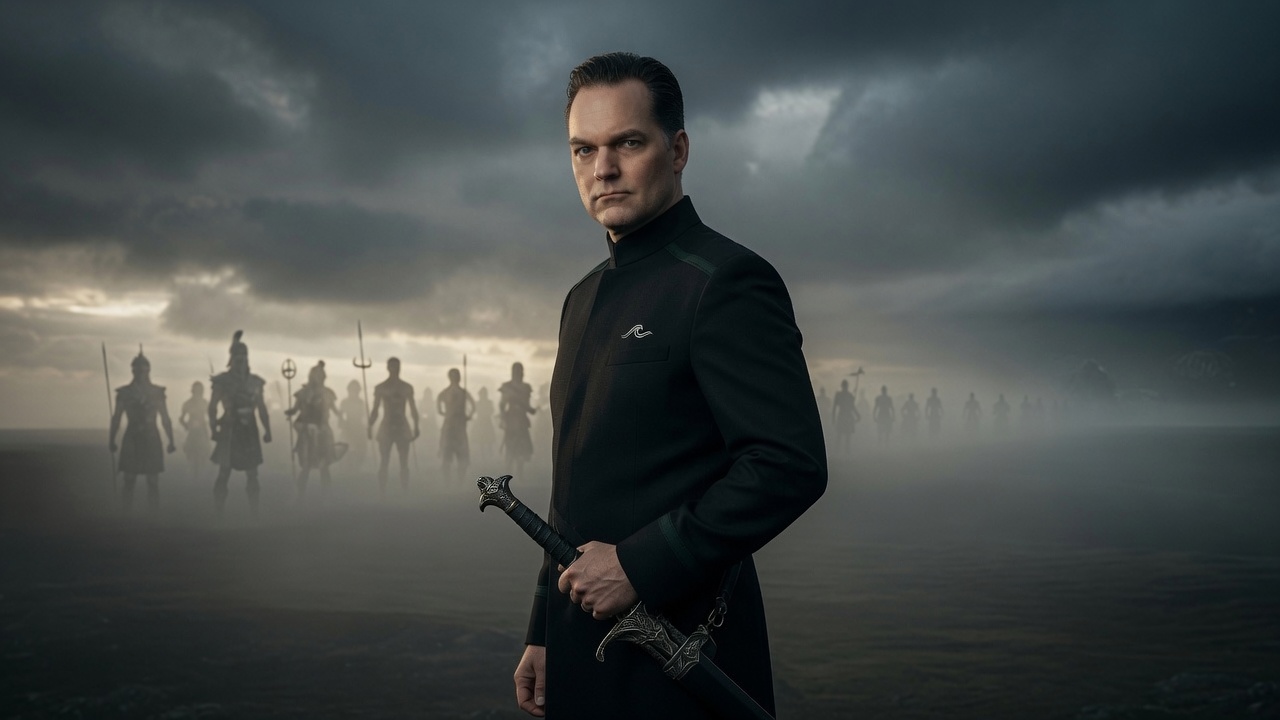
The Steward and the Long Line — guardian of memory, bridge between past and future.
The Diagnosticians
These men saw the sickness of modernity with unusual clarity.
Oswald Spengler
1880–1936Civilisational Cycles
Showed that civilisations are living organisms with life cycles. His analysis of the West as a late, declining culture remains one of the most precise diagnoses of the modern age.
Julius Evola
1898–1974Tradition & Hierarchy
Rejected the modern world in its entirety. He formulated the necessity of spiritual authority, hierarchy, and a return to the principles that once made European civilisation great.
Carl Schmitt
1888–1985Political Theology
Revealed the theological foundations behind modern political concepts. His work on sovereignty and large-scale political order remains essential for thinking at civilisational scale.
The Archeofuturists & Vitalists
These thinkers understood that tradition and the future are not enemies — they must be reconciled.
Guillaume Faye
1949–2019Archeofuturism
Gave the movement its clearest expression. He argued that advanced technology and archaic values must be combined if the European peoples are to survive and flourish in the twenty-first century.
Ernst Jünger
1895–1998The Waldgänger
Lived through the catastrophes of the modern world and developed the figure of the individual who can resist the totalising forces of the age while remaining rooted in deeper realities.
Filippo Tommaso Marinetti
1876–1944Futurist Vitalism
Embodied the explosive creative and vitalist energy that must coexist with tradition. His work embodies the tension at the heart of archeofuturism.
The Europeanists & Identitarians
These thinkers focused on the defence of European identity and the creation of larger structures capable of securing it.
Alain de Benoist
1943–Ethnopluralism
Developed one of the most coherent critiques of universalism and liberal modernity. His defence of the right of peoples to remain themselves remains fundamental to identitarian thought.
Oswald Mosley
1896–1980European Unity
Moved beyond narrow nationalism towards the vision of Europe as a united civilisational force — a third power capable of acting independently in the world.
Dominique Venner
1935–2013European Memory & Sacrifice
Embodied the spirit of the Long Line. His life and work centred on the defence of European identity, ancestral memory, and the will to sacrifice for the sacred.
Francis Parker Yockey
1917–1960Civilisational Imperium
Author of Imperium. One of the clearest voices calling for a united European civilisation capable of resisting both American materialism and Soviet totalitarianism.
Jean Thiriart
1922–1992Paneuropean Geopolitics
Developed a realistic geopolitical vision for a united Europe as a great power. He focused on strategic independence and continental scale.
Corneliu Zelea Codreanu
1899–1938Spiritual Nationalism
Led the Legionary Movement in Romania. He combined deep spirituality, the spirit of sacrifice, and national renewal. His emphasis on moral and spiritual regeneration remains powerful.
Troy Southgate
1965–Decentralised Identitarianism
Developed national-anarchist thought. He combines strong identitarianism with decentralised, state-critical structures — offering one of the clearest bridges to the Node model.
The Living Line
These men are part of the Long Line that runs through us. We do not treat them as infallible, but we recognise them as ancestors who saw further and deeper than most of their contemporaries.
The Wave does not merely inherit their ideas. We seek to complete what many of them began — to move from resistance and diagnosis to the active building of the Hearth, organised through Nodes.
We are not the end of their story. We are its continuation.