


What a Hearth is
A Hearth is a family, or a small cell of any number of members, led by its Steward. Every Brother and Sister belongs to a Hearth. It is the smallest unit the state may not dissolve.
The Hearth is the second pillar. The order is the Long Line, the Hearth, and the Steward. The Aegis is the shield around them. It is not a pillar.
When the Stewards of three to six Hearths meet, they form a Node.
Centre of Human Life
The Hearth is the oldest and most fundamental symbol of human civilisation. Long before nations, empires, or ideologies, people gathered around the fire. The Hearth represents the point where survival becomes something more than mere existence — it becomes home, belonging, and continuity.
In the Wave, the Hearth is not merely a romantic image of domestic life. It is the living centre of everything that makes a people capable of enduring across generations. It is the place where the most basic and important functions of human life are carried out: the raising of children, the transmission of values, the provision of security, and the formation of character.
What the Hearth Truly Represents
When we speak of the Hearth, we speak simultaneously of several interconnected realities:
The Family as Primary Unit
The family is the first and most natural form of human community. It is within the family that the deepest bonds of loyalty, love, and responsibility are formed. The Hearth recognises that no larger structure — whether state, corporation, or ideology — can replace the family as the foundation of a healthy society. When the family is weakened or redefined beyond recognition, the entire civilisation begins to lose its coherence. A Hearth may also be a small cell of any number of members, still led by its Steward.
Children as Living Future
Children are not merely a personal choice or a lifestyle option. They are the physical continuation of the Long Line. The Hearth exists to protect and raise the next generation with intention, discipline, and love. A people that ceases to have children, or ceases to raise them properly, has already begun to disappear — regardless of how advanced its technology or economy may appear.
Man and Woman — the Natural Order
The Hearth rests on the natural complementarity of man and woman. This is not merely a biological fact but a civilisational one. The stable union of man and woman creates the conditions under which children can be conceived, born, and raised with the greatest chance of becoming healthy and capable adults. The Hearth defends this fundamental reality against ideological attempts to dissolve or redefine it.
Security and Protection
The Hearth is a protected space. It represents the human need for security — not only physical security from external threats, but also emotional and spiritual security within the home. A society that cannot provide this elementary condition for its people has failed in its most basic task. The Hearth requires that family and community be able to defend themselves and their way of life.
Tradition and Transmission
Tradition is the accumulated wisdom of those who came before us. The Hearth is the place where this wisdom is passed from one generation to the next — through stories, rites, skills, and daily example. When tradition is attacked or rejected, every generation is forced to start from zero and loses the hard-won knowledge of its ancestors. The Hearth stands against this process of cultural amnesia.
Belonging and Meaning
Human beings need to belong to something real. The Hearth offers this belonging in its most immediate and powerful form. It is the place where a person is known, needed, and loved not for what they produce or consume, but simply for who they are within the chain of generations. This sense of rooted belonging is one of the most powerful forces against the alienation and despair of the modern age.
The Assault on the Hearth
Modern civilisation has waged a sustained campaign against the Hearth. Through economic pressure that forces both parents into the workforce, through cultural messages that devalue family and children, through policies that undermine parental authority, and through mass migration that disrupts community cohesion, the Hearth has been systematically weakened.
This is not an accident. A rootless, atomised population is easier to manage and easier to turn into consumers. The destruction of the Hearth serves the interests of those who benefit from a disconnected and dependent population. The Wave exists in direct opposition to this process.
The Hearth and the Long Line
The Hearth is the physical and spiritual beginning of the Long Line. It is where the chain is renewed in every generation. Without strong Hearths, the Long Line cannot be sustained. The transmission of blood, memory, character, and values begins in the home. Everything else — institutions, technology, defence — exists to serve and protect this central reality.
The Steward and the Hearth
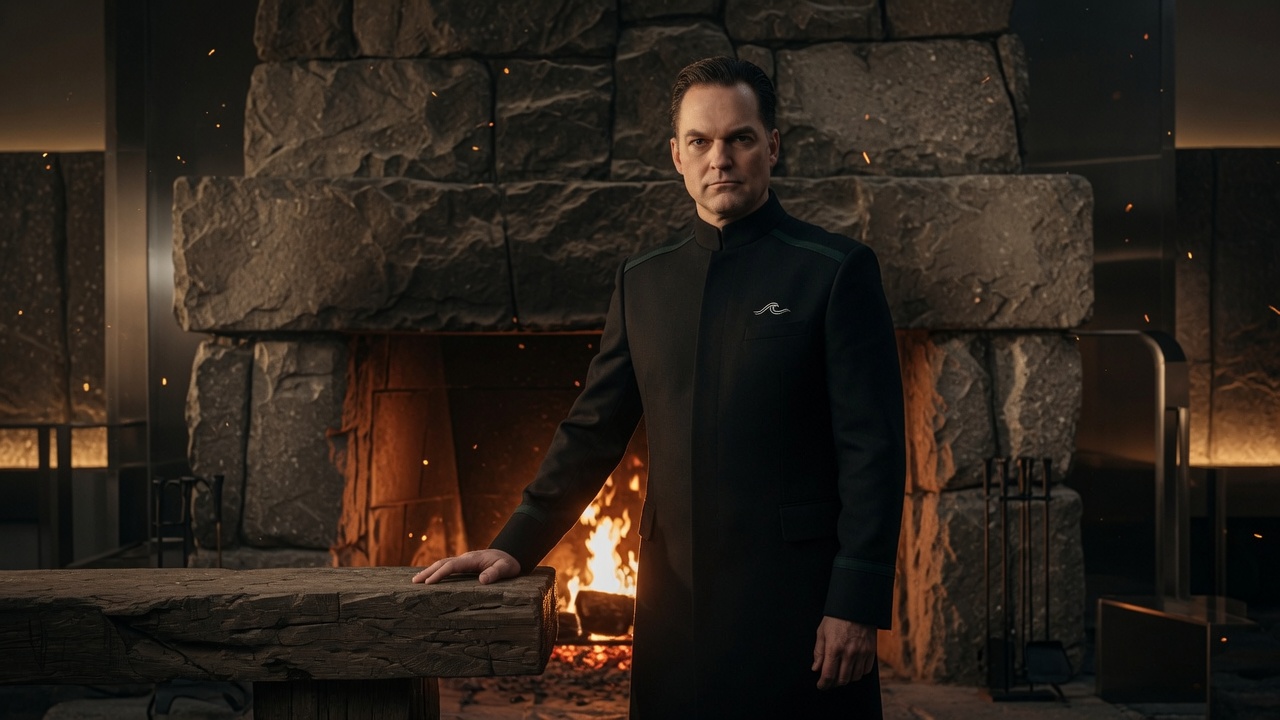
The Steward does not stand above the Hearth as a ruler. He stands in its service. His role is to protect the Hearth, strengthen it, and ensure that it can be passed on intact. The image of the Steward at the hearth-fire represents both guardianship and responsibility. He is the one who keeps the fire burning — not only the literal fire, but the inner fire of will, memory, and purpose.
The Hearth is the place where the Long Line begins and is renewed. It is where the fire — both literal and spiritual — is kept alive. To guard the Hearth is to guard the future of our people.